Let’s be honest. For most retail traders, the forex market feels like a vast, invisible ocean. You see the waves—the price quotes on your screen—but have no clue about the powerful currents moving beneath. That’s market microstructure. It’s the plumbing, the wiring, the hidden mechanics of how trades actually get done.
And understanding it? It’s your biggest edge. It moves you from guessing based on lagging indicators to seeing the market’s real-time heartbeat. Today, we’re pulling back the curtain on three critical components: ECNs, dark pools, and the art of order flow analysis. This isn’t just theory. It’s about seeing what was once invisible.
The Trading Floor is Digital: Meet the ECN
First up, the Electronic Communication Network, or ECN. Think of it as a massive, digital meeting place. It’s not a single company but a system that directly connects buyers and sellers—banks, hedge funds, retail brokers, even other ECNs. It’s a decentralized marketplace.
Why ECNs Matter to You
Well, if you’ve ever wondered about slippage or why your limit order didn’t fill at the exact price, the ECN is often the answer. Here’s the deal: on an ECN, you see a consolidated order book. That’s a live list of buy and sell orders at different price levels. It’s raw supply and demand.
The main perks? Transparency and, typically, tighter spreads. Since the ECN is just matching orders, it doesn’t trade against you. Your broker is just a conduit, not the counterparty. That said, you usually pay a small commission per trade for this access. It’s a trade-off: commission for, hopefully, better execution.
The Shadowy Depths: What Are Dark Pools in Forex?
Now, let’s talk about the murkier side. Dark pools. Sounds ominous, right? In reality, they’re just private exchanges where large institutions trade massive blocks of currency away from the public eye. The key word is undisplayed liquidity.
Imagine a whale—a big bank—needs to sell half a billion euros. Placing that order on a public ECN would move the market against them before the order is even half done. So, they use a dark pool. The order is hidden, matched privately, and only reported after the fact.
Can Retail Traders Access Dark Pools?
Directly? Almost never. But here’s the thing—you feel their effects. A huge trade executed in a dark pool doesn’t show up in the public order flow, but it still changes the market’s inventory. It can create sudden, seemingly inexplicable moves or areas of intense support/resistance. When price zips through a level without any visible selling on the ECN book… you might be seeing the ghost of a dark pool trade.
Reading the River: Order Flow Analysis Demystified
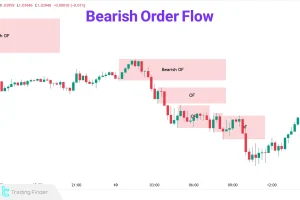
This is where it all comes together. If ECNs and dark pools are the venues, order flow analysis is your method for interpreting the action happening within them. It’s the practice of analyzing the real-time buying and selling pressure behind price movements.
You’re not just looking at a candlestick that closed green. You’re asking: Was that move driven by aggressive buyers hitting the ask, or passive sellers getting filled? The difference is everything.
Key Tools for Order Flow
Retail traders don’t see the full institutional book, but modern tools offer a window:
- Time & Sales (T&S): The raw tick data. Every single trade, its price, volume, and direction (buyer-initiated or seller-initiated). It’s a firehose of information, but learning to read it shows you where the aggression is.
- Depth of Market (DOM): That live order book we mentioned. Watching bids and offers get added, pulled, or eaten reveals where large resting orders sit—often like magnets for price.
- Footprint Charts: These are a game-changer. They break each candle into its constituent trades, showing you exactly at what price levels volume occurred. You can spot absorption (big orders being soaked up) or aggressive imbalances instantly.
Connecting the Dots: A Practical Microstructure Scenario
Let’s paint a picture. Say EUR/USD is approaching a major technical level at 1.0850. On your DOM, you see a massive buy wall at 1.0849. Price touches it, and the T&S shows a flurry of trades… but the wall holds. Then, it’s suddenly pulled. Price collapses 10 pips in a second.
What likely happened? A large player (maybe a bank) was providing liquidity, defending the level. They got filled on their large buy order, then removed their remaining liquidity, causing a vacuum and a swift move down. That’s order flow and ECN mechanics explaining a classic “stop hunt” or liquidity grab. Without microstructure knowledge, it’s just a weird wick. With it, it’s a readable market event.
Your Realistic Edge as a Retail Trader
Look, you won’t have the same data as a Wall Street firm. And that’s okay. The goal isn’t to see every single dark pool print. It’s to develop a more informed market feel.
Start by choosing an ECN-style broker that offers a DOM or advanced T&S. Spend time just observing. Watch how price reacts at order clusters. See how news spikes actually play out in the order book—is it a sustained surge of buying, or a quick spike that gets sold into?
This knowledge kills common retail pitfalls. You become less likely to buy at the top of a spike driven by exhaustion, or sell into a level where hidden buying is lurking. You start to think in terms of liquidity—where are the orders that move price attracted to?
In the end, the forex market’s microstructure isn’t a secret club. It’s just the logical framework of how modern trading works. By understanding ECNs, respecting the influence of dark pools, and learning to read order flow, you stop trading the ghost on the screen. You start trading the market beneath.